Ownership Over Tasks: A Mindset Shift in the Software Industry
Ownership Over Tasks: A Mindset Shift in the Software Industry
Throughout my journey in the software industry, starting from university projects and moving into company work and freelance projects, I have noticed one key factor that consistently separates average outcomes from great ones: ownership.
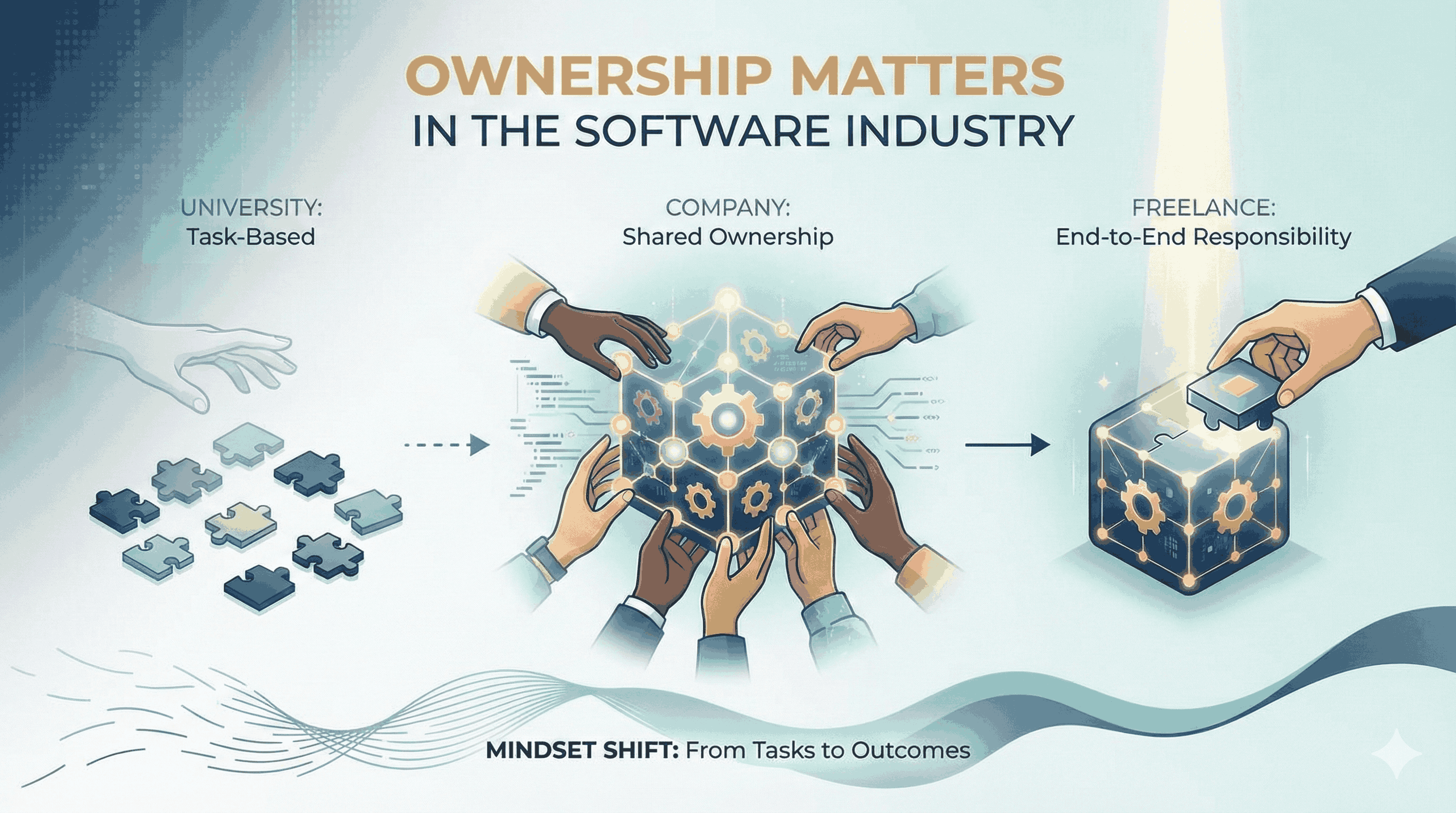
University Projects: Shared Work, Unshared Responsibility
In many university projects, tasks are divided among team members, but responsibility for the final result is often unclear. People usually focus only on what was assigned to them. If something is missing, broken, or poorly implemented, it is easy to say, “That was not my part.”
Research, refinement, and attention to detail are sometimes ignored because they are not explicitly required. The project may be submitted on time, but it rarely feels complete or well-polished. While this approach might work academically, it creates habits that do not translate well into real-world software development.
Company Culture: Where Ownership Defines Teams
When entering professional software teams, the importance of ownership becomes much clearer. In strong company cultures, engineers are encouraged to think beyond assigned tasks. They understand how their work impacts the entire system, the team, and the end user.
Teams that value ownership do not rely on constant supervision. People identify problems, communicate openly, and take responsibility for solutions. Friendly collaboration also plays a major role. Respectful discussions, helping teammates, and caring about shared success lead to better software and healthier work environments.
On the other hand, in environments where ownership is weak, work often becomes fragmented. Issues are passed around, accountability is unclear, and progress slows down. Over time, this affects both product quality and team morale.
Freelance Culture: Results Over Roles
Freelance work highlights ownership in its purest form. Clients are not concerned about task boundaries or internal roles. They care about one thing: results.
In freelance culture, successful developers are those who take full end-to-end responsibility. They research independently, clarify requirements, solve unexpected problems, and continue working until the job is truly done. There is no room for excuses or partial completion.
This mindset builds trust. When clients know they do not need to worry or micromanage, long-term relationships are formed naturally.
Caring About the Details That Are Never Asked For
An important part of ownership in software work is paying attention to small edge cases and details that are often not explicitly mentioned. Leaders and clients usually focus on the bigger picture. They may not point out every minor scenario, validation issue, or unusual user behavior.
Engineers with a strong ownership mindset naturally think about these edge cases. They ask what could fail, what could confuse users, and what might break under unexpected conditions. Instead of waiting for instructions, they improve these areas on their own. These small improvements prevent future issues and quietly raise the overall quality of the system.
Often, this is the difference between software that simply works and software that feels reliable and well-crafted.
The Value of an Ownership Mindset
Across universities, companies, and freelance work, the lesson remains the same. Technical skills are important, but mindset is equally critical. Being self-driven, proactive, and accountable reduces risk for teams and clients alike.
Ownership does not mean working alone or doing everything by yourself. It means caring deeply about the outcome, communicating clearly, supporting others, and taking responsibility from start to finish.
From my experience, shifting from a task-based mindset to an ownership-based mindset is one of the most valuable changes a software professional can make. It leads to better products, stronger teams, and more meaningful work.